Substack Isn’t Collapsing For Those Using It In A Finance & Investing Context
A piece arguing that Substack “will collapse” went viral last week. It’s a compelling read. In our sector of finance, it’s very likely wrong.

Upon reading Scott Carney’s (a popular YouTube-based [and other platforms including Substack] investigative journalist) piece on why Substack’s subscription model is collapsing, I found myself agreeing with this statement initially:
Early adopters on the platform did the best. Writers like Heather Cox Richardson and Matthew Yglesias arrived early and earned millions. But as more writers showed up the subscription revenue pie didn’t grow commensurately. Even with Substack’s discoverability mechanism (something that is missing on places like Ghost and Beehiv) it was getting more difficult to establish a real career here. - From: The Real Reason that Substack is Collapsing
I could see how early Substack newsletters were able to quickly build a massive following simply as they captured a large market share of the early pool of readers. I wish I was one of the early joiners, but I only started Substacking in mid-2025. I also do not know these specific creators enough to know how they may have reached that — for many - enviable status.
Upon further thinking, I struggled to fully accept the notion that hope is completely lost for anyone joining the platform as a creator, several years after its launch. Especially after seeing first hand, multiple accounts in my niche (finance, investing, biotech) or outside of that - creating their own communities within few months. Even taking a look at my own progress, I would say I was massively impressed and surprised, let alone by the achievements of accounts I admire such as: Biotech Compass, Big Pharma Sharma and others.
Have I reached a point where my Substack channel has become the primary career? Likely not.
Is that completely unlikely to ever happen? Most likely (and hopefully not).
Recent developments, since turning my channel to ‘paid’ have far exceeded my expectations, with more than 20 actual paid subscribers endorsing my ideas and writing - in just 3 months (and 12 months since starting to write for free).
And this is for a ‘gig’ that has been taking mostly (some of) my weekend free time, with posting sometimes being regular and other times less frequent. It makes you wonder, what would focusing full time on this yield 1 year later?
Judging from highly successful examples of peers writing finance and investing: a community of 10s or 20s of thousands of subscribers is not wishful thinking, but mathematically achievable - as long as one keeps going!
Is it possible that money is shifting away from other platforms (such as mainstream media) to ones like Substack and Spotify. There are certainly trends supporting that idea. This is in tandem with a significant mentality and cultural shift in the way people engage with news, education, opinion, and advice.
Job market shifts are also at play here. Many professionals in my industry have left big corporate jobs in highly regulated environments such as banking and have become their own boss, taking all the risk and all the gains as individual creators. The jury may still be out as to whether financially that was a ‘good’ move. But how would one judge that? Based on income generated…? What about one’s ability to be the only decision-maker of how they use their creative abilities and their own time..? For me, leaving my own corporate comfort, at the risk of losing a good income, I was able to gain my time back, which for a while was priceless.
The TAM* does not disappoint, even if competition is fierce
*Total Addressable Market
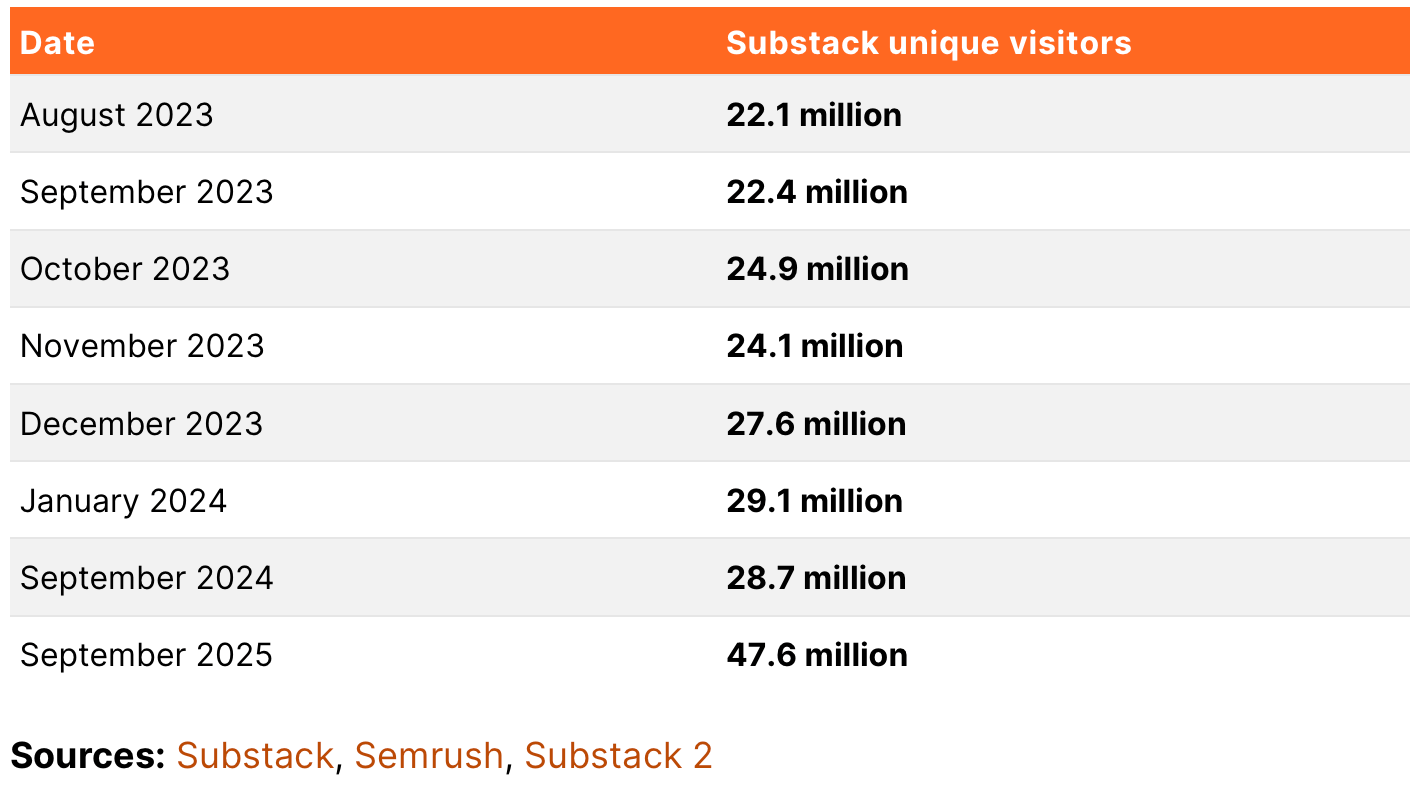
Taken from:

Set the niche aside for a second.
Substack is one of the fastest-growing media platforms in the world. Among the top 50 English-language news sites, only a handful grew at all last year and Substack grew by roughly 40%, while the field averaged low single digits and most sites shrank outright. Paid subscriptions have doubled, then doubled again, then once more; the last public milestone was 5 million. And the disposable-income argument that readers are simply being priced out doesn’t survive the actual numbers, which have risen, not fallen, since Substack crossed its first million paid subscribers. More writers are joining, so competition is brutal. True. But brutal competition is what a growing market looks like, not a collapsing one. Those are not the same thing.
Note to self: what if I translated my notes to other languages?
The overall trends on Substack are promising - I will let me peer do the backing up here…see below article:
For someone putting out investment content, it is important to note that the big investment banks charge institutional investor clients $1000 / hr to get them on a call and share advice on top stock picks.
Why can’t Substackers have the same opportunity to do so? That’s my first question…although I can understand that regulation is part of the answer.
The thesis is simple, and that’s part of why it landed. Scott Carney argues the subscription model can’t hold: readers have finite money and finite attention, and eventually the newsletters lose. When budgets tighten, your favourite writer takes a backseat to groceries. But this may be irrelevant in the field of finance, where (1) different ball-game of budgets exist; (2) ROIs are many (many) multiples of what a Substack subscription may cost.
Second question would be, why couldn’t institutional investors (VCs, private equities, asset managers, pension funds etc etc) allocate 1% of the millions they pay banks for financial advice, to credible, professional, Substack-based financial/investment content creators.
On the ROI argument I made earlier: I write about biotech catalysts (binary clinical readouts, PDUFA dates) the moments where a stock doubles or halves overnight. Readers are paying for ideas, for edge, for conviction. And that is worth something to a lot of people. Read my recent post where we made our portfolio/ideas tracker available to all our paid readers.
I do get friends and family ask me for biotech stock ideas - ALL the time. And it’s really never that simple (except in the case of ABVX 0.00%↑ …maybe this one, I will always recommend no matter what). There is nuance; there is levels of confidence; there is timing and there is risk. All these cannot be collapsed into one single-word stock recommendation…
Community is real…in ways I never imagined
Here’s what the doomsday view misses. The Substack community brought me in touch with people I would never imagine I could have a connection with:
EXHIBIT A: My Lp(a) post received a lot of interest and feedback. One of them was an expert physician and academic researcher who praised my analysis and with whom we later connected to exchange thoughts, ideas and ways we could collaborate more closely in different regards.
EXHIBIT B: The same post seemed to have reached a patient who was involved in the very clinical trial I wrote about, and which is pending a readout in the following months. The patient (a Substack reader) commented on my article, giving me thanks for the interest in writing about a topic that is important for their health.
EXHIBIT C: A client company reached out to me after reading my content and proposed to collaborate and 9 months later, this partnership has grown into something with a ridiculous ROI at the inception point of my Substack newsletter.
EXHIBIT D: CEOs and CFOs of the very same biotech companies I write about, are followers of my account. I rest my case there…
The reader’s side is even simpler
For a reader, the asymmetry is almost absurd. A year of expert biotech analysis costs less than a single share of most of the stocks it covers. One avoided catalyst blow-up covers a decade of subscriptions. Demand for that isn’t softening in my eyes, at least.
Imagine $AMLX: Stock is up 100% since my August publication - my first publication ever. Even that one - when I only had 50 followers and was still in the unpaid mode, compelled at least one reader who came across my LinkedIn post to donate $50. Possibly they made some money out of that trade recommendation, or possibly they liked my analysis. Who knows? Point is: I put out decent content, marketed it to my audience (Substack, LinkedIn etc); most people ignored it or rejected, but a handful appreciated it. Rinse and repeat is fine for me, thank you.
So, no
Substack isn’t collapsing. Not in finance, where good or even average investments have a clear, calculable return.
One final note: if you write in this niche and it’s been a slow year, the market didn’t shrink. It got harder to fake. Build the record. The readers who pay for edge aren’t going anywhere.
That’s the entire logic behind what I do here…one year after starting my newsletter, one year after leaving a cushy corporate job - no regrets; just perseverence doing what I enjoy.
Stay tuned — Thanks for reading — Systima Capital
Hey!
Great post and I agree with your conclusion. Most importantly, thanks for giving me proper credit and not just taking my work and rewriting it as your own :)
All the best,
Joseph